Games Writers Play #13: Grid and Dice

gwp“You can’t wait for inspiration.  You have to go after it with a club.” — Jack London

If you’re sitting around waiting for the perfect idea to pop into your head before you put a word on the page, you’re going to be waiting a long time.  Usually you never know when an idea is great anyway — it just happens along the way.  And even when you’re finished, you may think the end product is terrible, but your own opinion is often distorted because you’re comparing your work to some impossible ideal and not really seeing the true merits of what’s on the page.

Anyway, ideas are easy.  It’s what you do with those ideas that makes great writing.

Still, there are times when the ideas just won’t flow.  Here’s a neat game that can give you a jolt: Use a dice and a grid with story possibilities to create the bones of a new story.

This is geared toward fiction, but you could certainly adapt it to nonfiction.  For fiction, the bones of every story can generally be boiled down to a character in a setting with a problem.

A hobbit named Frodo [C] journeys across the ancient land of Middle Earth [S] to destroy the One Ring before the evil Sauron finds him [P].

In fact, you can boil almost every scene down to those essentials too.

Indiana Jones [C] races through a deadly cave [S] to avoid from getting crushed by a giant boulder [P].

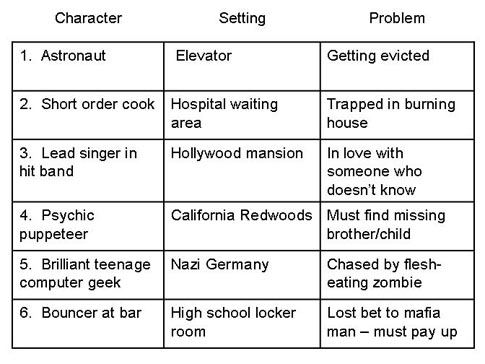
To play this game, create a 3 x 6 grid.  The three columns along the top should be labeled “Character,” “Setting,” and “Problem.”  Number the six rows on the left.  Now it’s time to do some brainstorming.  You need to come up with six characters, six settings, and six problems.  Be creative!  Here’s an example:

gamegrid

The next step is to roll the dice three times.  The first number chooses the character.  The second number chooses the setting.  The third chooses the problem.  Once you’ve got those, start your story and see where it goes.  Here’s a tip:  Don’t be too constrained.  If the story takes you in a different direction, go with it.

So let’s say I rolled a “3,” a “1” and a “6.”  That would give me a lead singer in a hit band who’s in an elevator and must pay off a bet to a mafia man.  My mind is already rolling . . .

-+-


One of the ways I can justify writing these “Games Writers Play” posts for free is by putting a donate button at the bottom of these posts.  If you find them useful, even a small donation of a couple dollars helps justify my time.  If you can’t donate, please help spread the word by linking to these posts.  Thanks!
-+-
All posts in this series can be found at
www.gameswritersplay.com

Story of the Month: “The Tiger in the Garden”

Here’s a story that originally appeared in the the June 2006 issue of Asimov’s. It’s always been a favorite of mine, and it’s reprinted in my collection, The Dinosaur Diaries and Other Tales Across Space and Time.  The opening is below; if you’d like to read the rest, you can buy it for the Kindle or read the PDF version on screen by purchasing it over at Scribd.  Or, of course, buy the collection.

tigercover

The Tiger in the Garden

by Scott William Carter

At precisely noon — not one minute earlier, not one minute later — the ship appeared in Regence’s sky. It started as a black dot in a perfect canvas of cobalt, like a drop of ink carelessly spilled from a painter’s brush. So small, so seemingly insignificant, and yet José felt his whole body tremor at the sight of it. The punctuality did not surprise him. Unless something had changed, this one was a Bal’ani, and they were said to obsessive about such things. José had made certain to arrive a half hour early at the landing station. On their home world the Bal’ani were rumored to eat those who insulted them.

“Constable Valcorez,” the attendant behind him said, “is that truly an Agent’s ship?”

“Yes,” José said. Hand raised to block the glare of the sun, he watched through the glass doors as the black dot grew quickly in size, soon filling almost his entire field of vision, until finally the ship’s thrusters stirred up a fog of dust on the bone-colored ground. Behind the pulsing electric fence that surrounded the landing area, the desolate plains extended flat to the horizon, making the ship that much more stark an appearance. He had seen vids of Agent ships, of course, but seeing one up close was both more awful and awe-inspiring. There were three other ships outside, freighters which were not small themselves, and the Agent ship was at least as big as all of them combined.

The hand of death, José thought. That’s what it looked like, with its black gleaming surface and five pincer-like landing gear. The hand of death descending on Regence . . .

——– continued ——–

Read the rest of the story:

[$1.49 Kindle]
[$1.49 Scribd]

Nice Review of A WEB OF BLACK WIDOWS

webblackcoverMy mini collection from PS Publishing, A Web of Black Widows and Other Stories of Love and Loss, has garnered some nice reviews.  This one over at Chizine.com (a leading online site dedicated to dark fantasy) is particularly good:

“Scott William Carter makes it look easy. But if anyone thinks that writing good, intriguing fiction with a clear, plain voice is easy . . . Well, they should try it sometime.

Carter seems to me to be a writer who will not box himself into any fiction category. He is a cross-genre traveller. And he travels far, casting his webbed net into strange seas, hauling up peculiar treasures.

All of these stories are restrained but involving pieces. All over this showcase represents the rise of a tall, wide and clean-cut talent, still developing in upwards motion.”

You can read the rest of the review here, which actually provides a nice summation of all six of the stories in the collection.

And of course you can buy the collection here!

Games Writers Play #12: Read Bad (Published) Writing

gwpAlthough I get a much stronger charge out of reading great writing, I have to admit that I get a little boost out of reading bad writing too — that is, bad writing that’s made its way into print by a major publisher.

Now, I’m not going to name any names, because again, this is subjective, but just about every writer has had the experience of reading something and at some point along the way (because often you don’t even manage to finish it) you say to yourself, “How did that get published?”

And you think to yourself, “Hey, if someone was willing to publish that, then I can certainly do it too.”

If you’re always comparing yourself to the masters, and you become aware of how big the gulf is between your level of craft and theirs, it’s easy to get discouraged.  But when you realize that the bar to getting published — and even getting widely read — is not that high, it can help sustain you during those discouraging moments.  It doesn’t even have to be bad.  Mediocre is probably a better word.

So don’t throw that bad novel in the garbage.  Keep it.  And when you’re feeling discouraged, pull it out and remind yourself that your writing doesn’t have to be perfect to be good.

The caveat, of course, is to make sure you’re still reaching for greatness.

-+-


One of the ways I can justify writing these “Games Writers Play” posts for free is by putting a donate button at the bottom of these posts.  If you find them useful, even a small donation of a couple dollars helps justify my time.  If you can’t donate, please help spread the word by linking to these posts.  Thanks!
-+-
All posts in this series can be found at
www.gameswritersplay.com