Conversations with Poe: Salinger

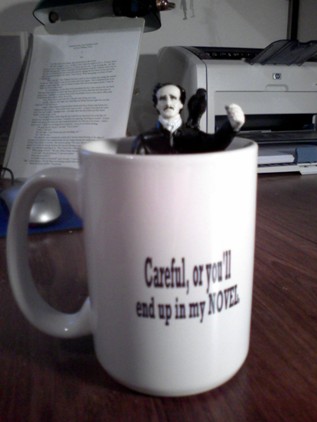
SSPX0794Poe:  So I heard J.D. died the other day.

Scott:  J.D.?  As in Salinger?

Poe:  Yes, didn’t you hear?

Scott:  Oh, I heard.  I’m just curious how the news got to you since I don’t have the Internet or the radio in here.

Poe:  Oh, you know, when you’re a famous writer, you tend to just know when one among us has passed. 

Scott:  Ah.  Well.  You see, you’re not really a famous writer.  You’re a fictional construct manifested by my imagination in the form of an action figure.

Poe:  Details, details. 

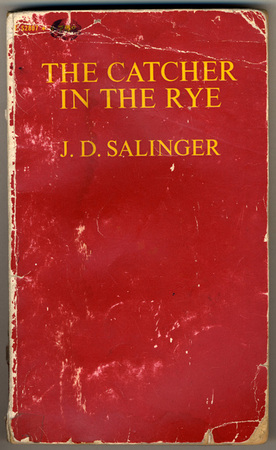
Scott:  You know, I have been thinking about Salinger lately, though.  I have to admit, when I sat down to write The Last Great Getaway of the Water Balloon Boys, there was part of me that really was trying to capture the same authenticity of voice that he did.  I’ve even described the story as Catcher in the Rye meets Thelma and Louise. 

Poe:  So what are you saying?  You want to move to New Hampshire and live as a hermit?
catherScott:  There are days.  But no, I’ve been thinking how there’s this rumor Salinger has a safe full of manuscripts.  I mean, he hasn’t published anything in over 50 years.  He told the New York Times a couple decades ago that he still writes, but just for him.  I’ve been thinking about whether that’s a good or bad thing. 

Poe:  How so?  If it makes him happy, what’s the difference?

Scott:  To him?  None.  Catcher made him extraordinarily rich, so he didn’t need to write for money any more.  But there’s something about writing for an audience, for readers, that I think demands a certain amount of engagement with the world.  Writing is communication, after all.  If you’re not communicating with anyone other than yourself, are you still communicating?

Poe:  Ah, but that’s not to say my friend J.D. wasn’t writing for readers.  He just didn’t feel rushed to share those later works with readers.  There’s a big difference between publication and writing.  Once it’s written, what’s the difference whether it’s read or not?  It doesn’t change what it is.  Take the Diary of Anne Frank.  An extraordinary work, and yet there’s no indication she was writing for anyone other than herself. 

Scott:  Well, that’s what I’m driving at.  That’s one book, not a career.  Sadly, we’ll never know what Frank would have written after that.  If I want to become the best storyteller I can be, how can I do that without some kind of feedback?  I’m not talking about critics, per se.  I’m talking about audience.  If you make a movie, how do you know if that movie entertains unless you screen it?  But there’s the other side of me that says you’re much more likely to stay true to your own unique vision, your own voice, the less you let others influence you — at least directly.  Influences are all around us. 

Poe:  Perhaps it’s best to do both.

Scott:  What do you mean?

Poe:  When you’re writing, you write only for you.  You shut out all the other voices.  But when you’re trying to get better, when you’re trying to learn, you have to be willing to open your mind.  That means you might get stung.  The key, of course, is to be able to shake off criticism without ignoring it completely.  It’s a balancing act.

Scott:  I agree . . . Hey, since good old J.D. is your pal, do you know if there really are dozens of manuscripts locked away?

Poe:  You’ll know soon enough.

Scott:  Hey now!  How about some gratitude?  I do put a roof over your head.

Poe:  Put an Internet connection in here and you’ll see some gratitude.
Games Writers Play #2: 25 Words a Day

gwpSince starting with 500 words may seem like too much for some writers, here’s a different approach.  I can’t remember where I heard this particular game, though I know I’ve heard it used by a number of successful authors.  It’s really quite simple:

You just have to write 25 words a day.

That’s it.  That’s your quota.  If you hit 25 words, then you give yourself permission to quit.  I reached that in the first paragraph, so you can see how ridiculously easy it is.  And that’s the point.

See, most of the battle of overcoming our natural resistance as human beings to doing anything that requires discipline is just getting our butts in the chair. Once your butt is in the chair, the word processor is fired up, and the first couple words are typed, you’re already well on your way.  Most of the time, you’ll actually find it hard to stop at just 25 words.

But not always.  Maybe you’re down with the flu, maybe you’re out late partying with Jay-Z, or maybe the creativity center of your brain is just coming up empty, and if that’s the case, give yourself permission to stop at 25 words.

The key is keeping a streak alive.  Creating momentum is one of the most powerful ways to boost your productivity.  Once you’ve got a streak of even a few weeks going, you’ll find you don’t want to miss.  Try it out.  You might be amazed after a couple weeks how the pages have added up.  It’s also a great game when you find yourself suffering from a long dry spell.  Because no matter how bad your writer’s block is, you can always write a couple sentences, right?

-+-


One of the ways I can justify writing these “Games Writers Play” posts for free is by putting a donate button at the bottom of these posts.  If you find them useful, even a small donation of a couple dollars helps justify my time.  If you can’t donate, please help spread the word by linking to these posts.  Thanks!
-+-
All posts in this series can be found at
www.gameswritersplay.com

Don’t Click the Comment Link

Note to self:  Dipping into the comments section in most political blogs is a good way to lose faith in humanity.  Worse, if you dip into the comments section of your local newspaper, you’ll not only lose faith in your fellow human beings, you’ll realize they live next door.

Somehow it’s easier when I can tell myself that all the crazies live somewhere else.  Albuquerque, maybe.

Yes, Virginia, There Is a Republican Party

grinch_lSo the supposed 60-vote filibuster proof Senate majority didn’t last long, did it?  Personally, I found it depressing that the voters in Massachusetts would replace Ted Kennedy, a man whose life purpose was to bring universal healthcare to one of the only democracies in the world without it, with a Republican who will now most assuredly walk in lockstep with a political party that made the calculation at the beginning of this year to use the filibuster more than any congress in history to oppose, delay, and obstruct the Democratic agenda in any way possible.  But that’s just me.  (And I could be wrong about Scott Brown, but I don’t think so.) 

What I found more depressing, however, was the immediate capitulation on healthcare by weak-kneed Democrats who are doing their best to reinforce the stereotype that Democrats are spineless. 

Look, healthcare reform may not be popular right now, but either was Social Security or Medicare when they were enacted.  Today you have even rightwing crazies spouting nonsense like “Don’t let the government take away my Medicare.”  Just goes you how far the pendulum can swing; history proves again and again that people like good government social programs once they get used to them, and conservatives know this, which is why they fight them tooth and nail. 

I’m also willing to make a prediction:  the Democrats don’t pass some kind of meaningful healthcare reform, they’re going to be slaughtered in November at the polls.  They might be slaughtered anyway — it’s just the way history works, the party in power during bad economic times get punished even if they weren’t the cause — but they’re guaranteeing that they’ll get slaughtered if they buckle under the pressure.  

The Republican line if healthcare doesn’tpass:  “You spent a year dithering on healthcare with nothing to show for it and we’re still in a recession!” 

The Republican line if healthcare doespass:  “You spent a year dithering on healthcare and passed it and we’re still in a recession!” 

The second line of attack might still have some traction, but at least it gives Obama and the Democrats a chance to sell the reform.  No reform, nothing to sell, that’s all she wrote.  You think we’ve got gridlock now?  Oh boy, just wait.

Think of it this way:  If 100,000 people voted differently in Massachusetts on Tuesday, I doubt some of these Democrats in Congress would be talking about scrapping healthcare reform.  So are 100,000 people going to decide the fate of 300 million?  If it was such a good idea a couple weeks ago when both houses of Congress passed sweeping healthcare reform bills, it’s now not a bad idea because 100,000 people in Massachusetts say so.  And honestly, we don’t even know that’s what they were saying.  It’s far more likely that Martha Coakley was just a terrible candidate.    

So buck up, Democrats. Show some spine.  Don’t reinforce the steretype.  Don’t be swayed by the madness of crowds.  If you do what’s right for the country, history will prove you correct every time.  

That’s it for the soapbox today.  Now back to your regularly scheduled programming.