How Online Are You? A Writer’s Scale of Internet Engagement

On Saturday, I went to the coast for a “Writing Technology Day” with a bunch of  professional writers, where I spent the majority of it helping friends with things like using WordPress and putting stories up on Kindle.  It was also an opportunity for me to brainstorm and bounce ideas off some sharp minds about what it means to be a writer in the digital age.  It was fun, and it was one of those rare times when my day job (I’m an Instructional Technologist for a university, where I’m chiefly responsible for supporting the online classes) intersected with my writing life. 

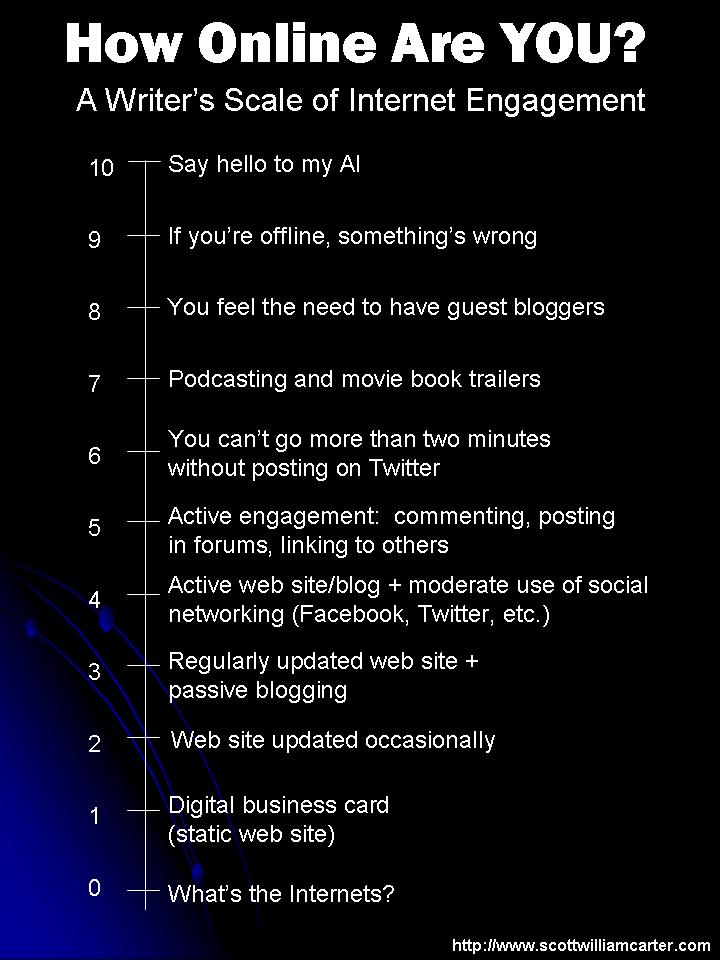
One of the things I got to thinking about was how online a writer should be.  Here’s a little scale I created so that writers can see where they fall in the continuum: 

writersonline_s

I do think every writer should have at least a moderately updated web page, with contact info and credits, but beyond that I think it depends a lot on mindset and goals.  Personally, I think if you’re serious about being a professional writer, then you really can’t afford not to explore some of the opportunities the Internet provides.  But it’s always a question of how much time you’re willing to commit and how much you enjoy it.  Writers like Cory Doctorow, John Scalzi, Jay Lake, Michael Stackpole, and Jeff Vandermeer are people I can think of right away that are on the high end of this scale, and they are all doing different things well.  Check out their sites and you’ll quickly see that these are writers making heavy use of all the digital tools at their disposal. 

However, I’d actually rank someone like Neil Gaiman — who has a million followers on Twitter, and has one of the most visited blogs on the Internet — lower on the scale even though his Internet traffic is off the charts.  He’s certainly engaged with the online community, but not to the extent of the other writers I mentioned.  His enormous web traffic is coming almost entirely from his work.  If you write bestsellers, and if you win major awards like the Newbery, you’re going to have a Web presence.  You don’t even have to go looking for it. 

To me it’s a reminder that if you want to be a fiction writer first, and not a blogger first, make sure the vast majority of your writing time and effort is devoted to your fiction.  To prevent the Internet from becoming a major time sink, you might draw up a chart figuring out where your writing time goes, as I did: 

Percentage Activity Hours Per Week
40% Writing fiction 8
35% Reading
5% Email 1
5% Website updating/blogging 1
5% Twitter/Facebook/social networking 1
5% Marketing/mailing 1
5% Internet reading/surfing 1


With a day job and a family, I aim to spend 20 hours a week on writing-related activities.  If I’m spending more than 5 hours of my 20 hours a week on anything outside of writing and reading, then I figure my balance is out of whack.  And yes, I do figure reading into my writing-related activities.  I don’t know how you can be a writer if you’re not reading heavily.  It’s our creative fuel. 

I don’t think there’s any right answer here.  If you have professional aspirations as a writer, then you should probably be at least at level 2.  Anything less probably hurts you when an editor goes out and Google’s your name — which pretty much happens automatically these days when a publisher is considering your work.  Does the writer have a Web presence?  If so, is it a good one or a bad one?  Are they out there making themselves look like an idiot?

Beyond that, it’s a question of how much time you’re willing to commit versus what you think you’ll get out of it.  If it’s fun, that makes it easier.  I actually enjoy posting on Facebook and Twitter ocassionally, but I have to be careful or the Web sucks me in like a black hole.  Take this blog post.  I could have spent this past hour working on fiction, but I wrote this instead.  Was it time well spent? 

For me, it was, because it falls within the guidelines I set for myself based on all the criteria I mentioned — criteria which could very well change just as my career does.  But every writer will answer that question differently.   My advice to writers is to 1) be aware of where you are on the chart, 2) and be conscious of the choices you’re making with your time.

Check out the 10’ers

The 10’ers is a livejournal community of young adult and middle grade authors whose books are debuting in 2010.  Lots of great stuff on the site.  I recently joined, and you can find my introductory bio here:  http://community.livejournal.com/10_ers/322902.html.  I might cross post there from time to time, if the subject matter also seems appropriate for that site.

There’s over 80 other authors listed on the site.    Check them out!

Conversations with Poe: Are Writers Just Self-Promoting to Each Other?

My Muse

Me: You know, looking at a lot of the online self-promotion that writers do, I sometimes wonder if most of it is just being seen by other writers — book trailers, guest blogging, that sort of thing.

Poe: Is that such a bad thing?

Me: Well, the hope is that your promotional efforts reach plain old readers too.

Poe: Aren’t writers also readers?

Me: Well, yes . . .

Poe: In fact, wouldn’t you say that writers are quite likely to be the most avid readers out there — not only buying more books, but also being the type of person most likely to thrust that beloved book into the hands of someone else?

Me: Hmm. What’s your point?

Poe:My point, fellow scribe, is that if your goal is to reach the most enthusastic readers possible, then you’re quite likely to find them among your fellow writers. It’s like in Malcom Gladwell’s Book, The Tipping Point

Me: Wait a minute. You read that book?

Poe: Certainly. It’s on your bookshelf there.

Me: But you’re like four inches tall. How’d you–

Poe: I’m locked in your office all day. I have a lot of time on my hands. The point is, Gladwell writes about how those early enthusiasts of any product, call them early adopters or what have you, can by instrumental in getting the word out about any product — whether it be shoes, technology, or even books. I think it’s quite likely that by promoting your work to other writers you have a decent chance of reaching enthusiastic readers who might just spread the word to those readers who aren’t writers.

Me: Ah. You’re pretty smart for a piece of plastic.

Poe: Don’t insult me. I’m a poet.

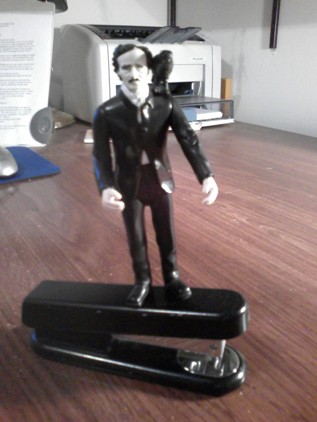
A lot of people know that I’ve got an Edgar Allan Poe action figure in my writing office at home, complete with a miniature raven on his shoulder.  He sits by my computer and looks on while I type.  After a while, I started talking to him, sharing my concerns about writing, family, and life in general.  One day, amazingly, he started talking back. 
Back on the Write Every Day Bandwagon

A few weeks ago, I looked back at my word counts the past seven years and noticed something quite surprising:  The first year I got very serious about writing — in other words, treating it like a profession and not a hobby — is still my best word count year.  I wrote just over 250,000 words of fiction that year. 

Now, according to my spreadsheet, I’ve written about a million and a half words in the past seven years, so it’s not like I’ve been slacking.  Still, it’s not the level of productivity I’m happy with, not the level of productivity that I think will get me where I want to go, so I started asking myself why I didn’t exceed or at least maintain my yearly word count after that first year.  Except for a bad year in there when I was dealing with some personal issues, for the most part I’m just as serious if not more serious about the craft as I was that first year.  

Why the difference?  When I dig into the nitty gritty of the spreadsheet, it’s obvious why:  Back then I made myself write every day. 

It’s a cliche, really.  You hear it from lots of writers that you should write every day.  I’ve gone through periods the last few years where I’ve done exactly that, but I often drifted back into a five day a week routine or worse, just scheduling marathon writing days a couple times a month.  I told myself this was partly due to my life, with two young kids, a day job, and other responsibilities, but really, the numbers just don’t justify this thinking.  The numbers that first year show that it was a lot of little word counts that added up to a big result in the end.  

So  I’m back on the write every day bandwagon, determined to make this year the best word count year so far — which should happen, if I stay at my current pace.  As I mentioned a couple weeks ago, I came to 1000 words a day as the quota that works for me.  What’s really interesting is how quickly I’ve become dependent on it.  It was almost like my psyche breathed a huge sigh of relief.  There was a restlessness, an uneasiness in my personality that’s been building the last few years, and it wasn’t obvious what it was until recently. 

I’ve gotten addicted to writing.  I just hadn’t realized it yet. 

When I started writing, just writing when the mood struck, it was always fun.  When I got serious about writing, writing whether I was in the mood or not, it wasn’t always fun.  On the days when it wasn’t fun, I had to push myself into my office.  What’s interesting about the addiction is that even on the days when writing doesn’t seem fun, there’s something else pulling me to the keyboard.  It’s that feeling that if I don’t write, I won’t be right. 

Is this a good thing?  Well, it’s gotten me to write more, and it’s gotten rid of the restlessness.  Addiction can be a dangerous business, but if it’s channeled into something with few negative side effects — I guess I have to watch out for carpal tunnel syndrome — then it’s a lot better than being addicted to something far more destructive.