Yesterday, when I picked up Calvin from preschool, I talked to him for a while, asked him if he was ready to go, and then . . . realized it wasn’t Calvin but a near doppleganger. What does it say about me that my first thought upon realizing this was, “Why does Calvin’s face look different?”
A Blog Post Fifteen Years in the Making
A week ago, I went out to the Oregon coast and spoke to a writer’s workshop about how I sold my first book. It was a week-long workshop focused on how to sell your fiction — writing queries, crafting proposals, targeting editors and agents, and generally getting a better understanding of the publishing business. Since my story had a few interesting twists and turns, including switching literary agents at one point, the teachers thought it might serve as a good example. And for these particular teachers, I was more than happy to do anything I could to help pay it forward.
That’s because I’ve known these teachers — both prolific, longterm professional fiction writers — for fifteen years. I realized this driving back from the coast. I met Kristine Kathryn Rusch and Dean Wesley Smith when I was a green nineteen-year-old college student when I wandered into the open weekly writing workshop they were running down in Eugene, Oregon, brought there by my friend Michael Totten, whose now become a notable writer in his own right. The funny thing is, I went to the University of Oregon because I thought that’s where I would learn how to be a writer, but I ended up learning far more about writing by attending the workshop for the next three years. At least half the people in that workshop were reguarly selling books and short stories.
Why am I telling you this? Because if you live anywhere in the vicinity of Lincoln City, Oregon — and for my part, because of how valuable I feel their teaching is, I define vicinityas anywhere on planet Earth — you, too, have the opportunity to benefit from Kris and Dean’s teaching. At two distinct points in my life, I was able to benefit from their knoweledge and experience. I would never say I’m a writer because of them, but I would say I’m incredibly grateful to them for their willingness to share what they’ve learned, and I’m pretty confident in saying they helped me cut years off my development as a writer. Sure, they’re charging for their workshops to cover their time, but trust me, they could make more money with that same time writing fiction. They do this to pay it forward.
Every few years, they do a series of workshops, some for a weekend, some as long as two weeks, whose sole purpose is to help writers learn to write better and sell more frequently. These are workshops specifically targeted at professional fiction writers. If you want to learn how to do something professionally, the best way is to learn from folks who have walked the path.
Kris and Dean have walked the path. Both have published dozens upon dozens of novels, in many genres, in many names, hitting bestseller lists and winning awards. They’re ordinarily pretty selective about who they take as students, but right now they’re offering a workshop targeted at any writer who’s even thought about the possibility of writing publishable fiction. They call it the Kris and Dean show. It’s a weekend out of your life, on the lovely Oregon coast. If you have any thought of writing for publication, then you should take this workshop.
It’s interesting: Michael Totten told me he brought along a dozen or so writers over the years to that Eugene workshop, all of them supposedly serious writers. But I was the only one who came back. Part of the reason for this, I think, is purely human psychology. Those writers were paying good money for their English or Journalism or MFA degrees, and the weekly workshop was free, so how could the free workshop be worth more? How could it be worth anything? You pay for what you get, right?
Sure, but when it comes to achieving success in writing, or really anything, the primary payment is not in money. It’s in time and effort. If you find good teachers, the ones who have walked the path, and you’re willing to put in the time and effort, you will get what you paid for in blood, sweat, and tears.
The key is knowing a good thing when you see it. It still boggles my mind how many writers don’t understand what a rare thing Kris and Dean’s workshops are. But I suppose that’s fitting. A real professional fiction writer is a rarity, too, right?
Recent Reads
- Wicked Lovely, Melissa Marr. Listened to this one as an audio book, and it lived up to its title: It was both wicked and lovely. A short, engaging YA novel about one teenage girl’s struggle to find her identity — while also struggling with her unusual ability to see a world populated by fairies, with a love story thrown in for good measure.
- Uglies, Pretties, and Specials, Scott Westerfield. I’d heard a lot about Westerfield’s far future YA series, so I decided to give them a shot. I was not disappointed. Tally Youngblood proved to be a very engaging main character, and well worth spending three books with. I can also see why the first book became a bestseller, because it has one of the best opening chapters I’ve seen in a while.
- Baby, Would I Lie?, Donald E. Westlake. Short, punchy and fun. An aging country western star is on trial for murder. Throw in a spunky female journalist, and a nice twist ending, and you’ve got yourself a good read. I’d never read any Westlake, and always wanted to try him; now I have to go find more of his books.
- What Do You Care What Other People Think?, Richard Feynman. A short nonfiction memoir by the Nobel Prize laureate. I’d read and enjoyed Feynman’s Surely You’re Joking, Mister Feynman?, and I liked this one too, especially the chapters that focused on his part in the committee investigating the Challenger space shuttle disaster.
Postcards from the Garage: There’s a Genius in My Office
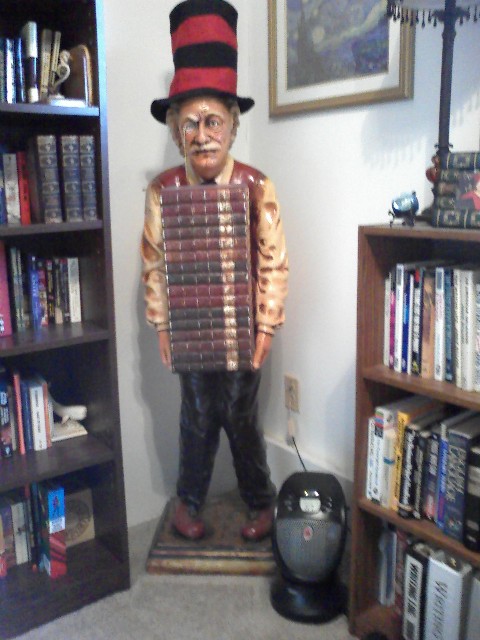
I’m not bragging here, but not every writer has the benefit of a genius in his office — like I do, with good old Albert Einstein. Especially a genius wearing a hat from The Cat in the Hat.
Actually, Albert was a gift from my parents, who bought him for me when I started a bookstore. And when I sold the store, he was the only thing I took with me. We’ve developed a good friendship. He doesn’t say much, but that’s okay. He’s a genius, so he doesn’t have to.