
Games Writers Play #13: Grid and Dice

gwp“You can’t wait for inspiration.  You have to go after it with a club.” — Jack London

If you’re sitting around waiting for the perfect idea to pop into your head before you put a word on the page, you’re going to be waiting a long time.  Usually you never know when an idea is great anyway — it just happens along the way.  And even when you’re finished, you may think the end product is terrible, but your own opinion is often distorted because you’re comparing your work to some impossible ideal and not really seeing the true merits of what’s on the page.

Anyway, ideas are easy.  It’s what you do with those ideas that makes great writing.

Still, there are times when the ideas just won’t flow.  Here’s a neat game that can give you a jolt: Use a dice and a grid with story possibilities to create the bones of a new story.

This is geared toward fiction, but you could certainly adapt it to nonfiction.  For fiction, the bones of every story can generally be boiled down to a character in a setting with a problem.

A hobbit named Frodo [C] journeys across the ancient land of Middle Earth [S] to destroy the One Ring before the evil Sauron finds him [P].

In fact, you can boil almost every scene down to those essentials too.

Indiana Jones [C] races through a deadly cave [S] to avoid from getting crushed by a giant boulder [P].

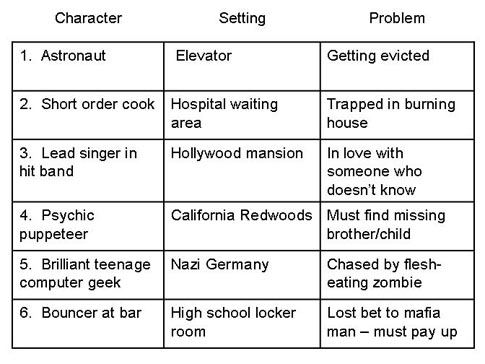
To play this game, create a 3 x 6 grid.  The three columns along the top should be labeled “Character,” “Setting,” and “Problem.”  Number the six rows on the left.  Now it’s time to do some brainstorming.  You need to come up with six characters, six settings, and six problems.  Be creative!  Here’s an example:
gamegrid

The next step is to roll the dice three times.  The first number chooses the character.  The second number chooses the setting.  The third chooses the problem.  Once you’ve got those, start your story and see where it goes.  Here’s a tip:  Don’t be too constrained.  If the story takes you in a different direction, go with it.

So let’s say I rolled a “3,” a “1” and a “6.”  That would give me a lead singer in a hit band who’s in an elevator and must pay off a bet to a mafia man.  My mind is already rolling . . .

-+-


One of the ways I can justify writing these “Games Writers Play” posts for free is by putting a donate button at the bottom of these posts.  If you find them useful, even a small donation of a couple dollars helps justify my time.  If you can’t donate, please help spread the word by linking to these posts.  Thanks!
-+-
All posts in this series can be found at
www.gameswritersplay.com

Games Writers Play #12: Read Bad (Published) Writing

gwpAlthough I get a much stronger charge out of reading great writing, I have to admit that I get a little boost out of reading bad writing too — that is, bad writing that’s made its way into print by a major publisher.

Now, I’m not going to name any names, because again, this is subjective, but just about every writer has had the experience of reading something and at some point along the way (because often you don’t even manage to finish it) you say to yourself, “How did that get published?”

And you think to yourself, “Hey, if someone was willing to publish that, then I can certainly do it too.”

If you’re always comparing yourself to the masters, and you become aware of how big the gulf is between your level of craft and theirs, it’s easy to get discouraged.  But when you realize that the bar to getting published — and even getting widely read — is not that high, it can help sustain you during those discouraging moments.  It doesn’t even have to be bad.  Mediocre is probably a better word.

So don’t throw that bad novel in the garbage.  Keep it.  And when you’re feeling discouraged, pull it out and remind yourself that your writing doesn’t have to be perfect to be good.

The caveat, of course, is to make sure you’re still reaching for greatness.

-+-


One of the ways I can justify writing these “Games Writers Play” posts for free is by putting a donate button at the bottom of these posts.  If you find them useful, even a small donation of a couple dollars helps justify my time.  If you can’t donate, please help spread the word by linking to these posts.  Thanks!
-+-
All posts in this series can be found at
www.gameswritersplay.com

Games Writers Play #11: Read Great Writing

gwpIt never fails.  Whenever I find my creative well running  dry, I get a charge out of reading great writing.

Of course, great writing is subjective, so what I find great will be different than what you find great.  But almost all writers can name a couple of influential books that inspired them along the way, books that made them want to write something equally as good.  I’m not talking works by Shakespeare or Joyce or Chaucer either, although it certainly could be.  I’m talking about books that made you fall in love with reading — Lord of the Rings, Catcher in the Rye, Pride and Prejudice . . .

It’s even better when it’s a modern book, one written in a style that’s still popular.  Maybe it’s an author you really admire.  For me, Stephen King is one of the first writers I grab, because he writes with the kind of engaging voice and clear style that I’m reaching for in my own writing.

So here’s the game in a nutshell:   If you need a creative boost, grab one of your favorite books and turn to one of your favorite passages.  Read it aloud.  It won’t be long before you feel that creative impulse return, the impulse that says, “I want to write something as good as that.”

-+-


One of the ways I can justify writing these “Games Writers Play” posts for free is by putting a donate button at the bottom of these posts.  If you find them useful, even a small donation of a couple dollars helps justify my time.  If you can’t donate, please help spread the word by linking to these posts.  Thanks!
-+-
All posts in this series can be found at
www.gameswritersplay.com

Games Writers Play #7: Write As Much as You Can in an Hour

gwpI personally believe that setting word or page quotas is much more effective than time quotas. This is mostly because if you tell yourself you’re going to sit in the chair until you’ve written a thousand words, you’ll find your fingers leaping into action much faster than if your fingers know that all you have to do is sit in the chair for an hour to call it a success.   (I realize we’re attributing a lot of independent brain power to those fingers, but bear with me.)   But I know that word quotas just don’t work for everyone. Some people find themselves freezing up if they know they have to write a certain number of pages.

I still can’t quite recommend just saying “write for an hour,” because that goes against some of the basic writing principles that I believe — that writing faster is generally better, that anything you can do to encourage yourself to write faster is helpful in keeping ahead of your critical voice.

So here’s a variation that works for me: Write as many words as you possibly can in one hour, and then track your progress.

Or thirty minutes. Or fifteen minutes. In fact, it’s probably a good idea to start with less time and work your way up.  Maybe you start by writing 250 words in an hour. Then it goes up to 500. Soon it’s 750. Rather than focusing on something you can’t control — why a particular story or novel hasn’t sold, etc. — you’ll have a measurable way to evaluate your success in an area you can control.  And that’s definitely a good thing.

-+-


One of the ways I can justify writing these “Games Writers Play” posts for free is by putting a donate button at the bottom of these posts.  If you find them useful, even a small donation of a couple dollars helps justify my time.  If you can’t donate, please help spread the word by linking to these posts.  Thanks!
-+-
All posts in this series can be found at
www.gameswritersplay.com